
Every December, Brisbane glows in a way that feels different from anywhere else. There is no snow, no winter frost, no reason to huddle indoors. Instead, our Christmas is shaped by warm nights, mango-sweet breezes, thunderstorms rolling over the ranges, and the golden light of long summer twilights. And at the heart of this season are two places — one grand and one civic — that hold some of our strongest Christmas memories: Government House at Fernberg, and the Christmas tree in King George Square.
Together, they tell a story of heritage, community, and how Brisbane has made Christmas its own.
Fernberg at Christmas: A Tradition of Doors Open & Lights On
For more than a century, Government House — Fernberg — has stood on the hill at Bardon, a stately home wrapped in deep verandahs, Moreton Bay figs, and sweeping lawns. In December, something magical happens: the estate opens its gates after dusk, and thousands of Queenslanders wander through a place that, for most of the year, sits quietly behind foliage and fences.
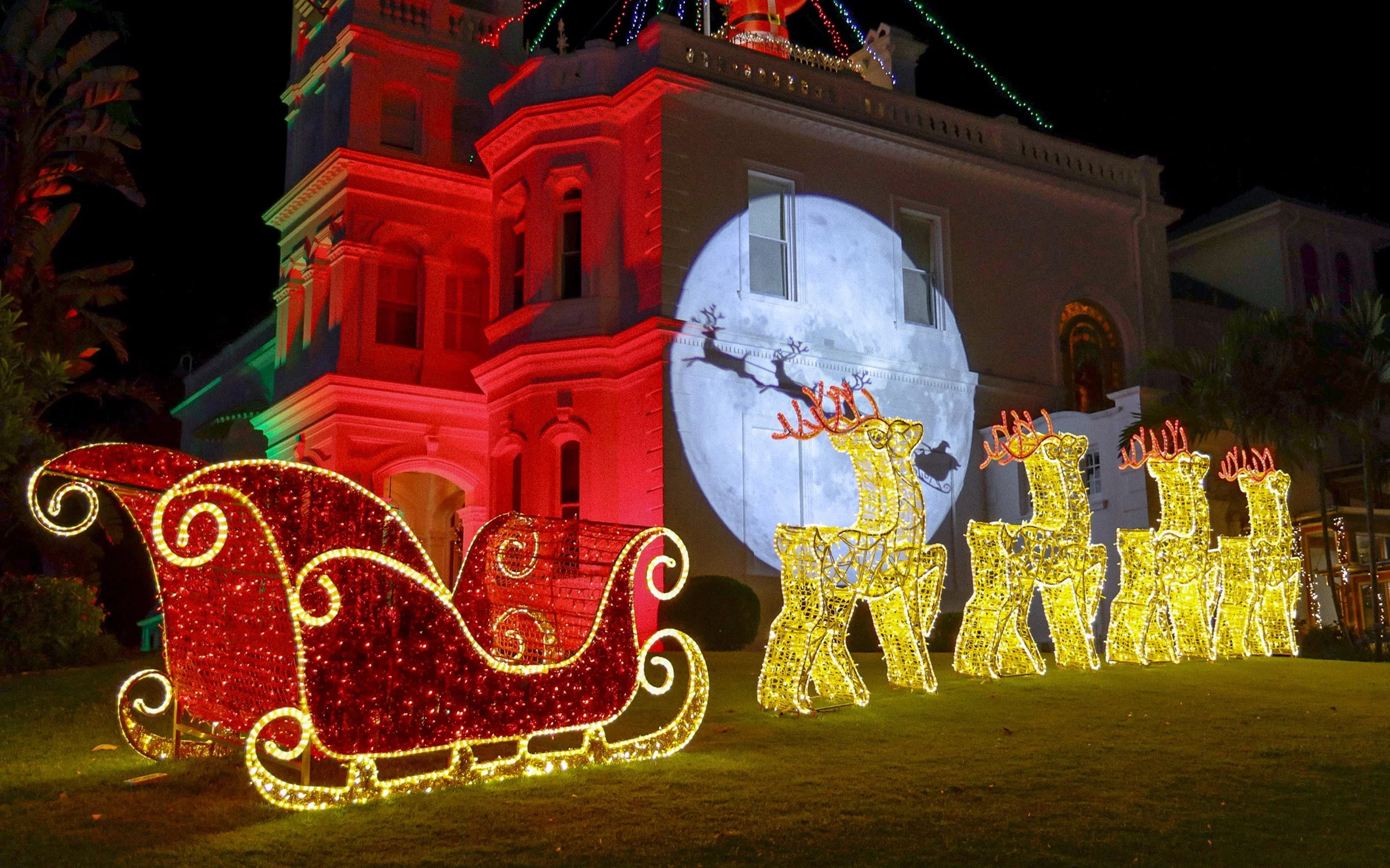
The Christmas lights at Fernberg are now a beloved tradition. Families stroll through the heritage gardens, children point out glowing reindeer beside 19th-century stonework, and carols drift across the lawns. Inside the house, the grand Christmas tree often features decorations created by Queensland artists — including First Nations artists whose work brings a contemporary voice into this historic home. Every visit becomes a gentle blend of past and present: colonial architecture illuminated by modern creativity, official residence becoming community gathering place.
It’s a small miracle of Brisbane Christmas — that the oldest symbols of authority can feel so warm, so open, so deeply part of the city’s shared festive story.

The King George Square Tree: From Forest Pine to Solar Giant
Across the river from Fernberg, in the heart of the CBD, another tradition has been growing — literally — for decades.
Brisbane’s first public Christmas trees appeared in the mid-20th century, when council workers would source enormous hoop pines from the forests near Mount Crosby, haul them into the city, and raise them in what is now King George Square. These trees were real, fragrant, and imperfect — sometimes lopsided, sometimes shedding needles in the heat — but they were loved.
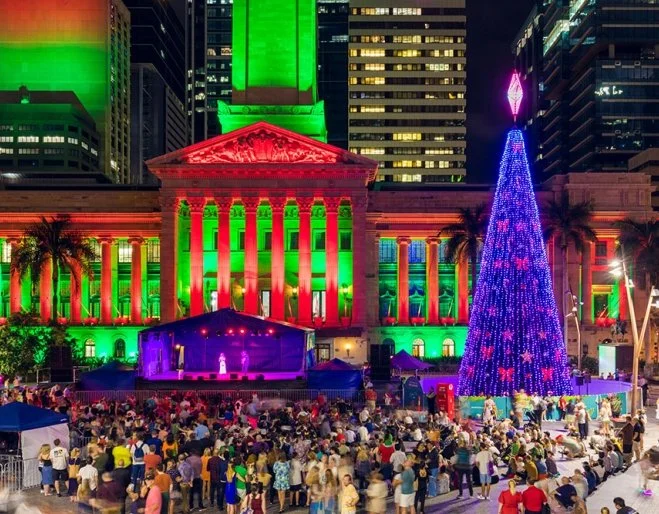
As Brisbane grew, the city’s sunshine presented a problem: live trees struggled to survive the season. In the 2000s, the tradition evolved. The city introduced a magnificent artificial tree, towering above the square, and in 2009 it received a major upgrade that made it one of the world’s largest solar-powered Christmas trees. Powered by Brisbane’s endless daylight, it was a uniquely Queensland solution: festive tradition shaped by innovation, sustainability, and a very sunny climate.
Today, the lighting of the King George Square tree marks the unofficial beginning of Christmas in Brisbane. Crowds gather beneath City Hall’s clock tower, the lights flicker on against the warm night, and for a moment the whole square becomes a living room shared by the entire city.
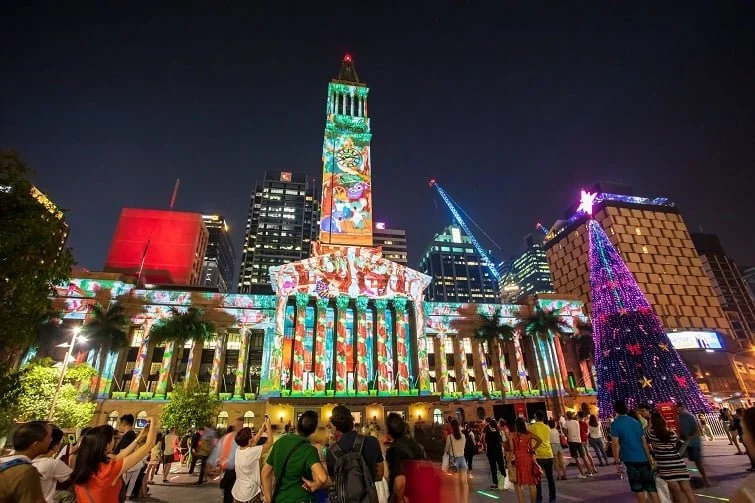
Two Sites, One Story: The Heritage of Summer Christmas
When you put Fernberg and King George Square side by side, a story emerges — a story about what Brisbane cares about during the festive season.
We return to Fernberg for its sense of continuity: the quiet reassurance of a house that has watched over the city for more than a hundred years. And we return to King George Square for its sense of collective celebration: the bustling energy of a city gathering under one glowing symbol.
Both traditions reveal how Brisbane has crafted a Christmas that fits our climate, our history, and our character.
It’s a Christmas of warm nights, of open doors, of heritage buildings lit like lanterns, of community over extravagance, of sun-powered trees, and of a city that celebrates not by escaping the heat, but by stepping into it — together.
A Final Reflection
Perhaps this is what makes Christmas in Brisbane special: it isn’t built on snow or nostalgia for colder places. It’s built on light — the lights that shine from a 19th-century verandah at Bardon, and the lights that radiate from a solar-powered tree in the city’s heart.
Heritage here is not something we preserve behind glass; it’s something we walk through, gather beneath, and illuminate each year. In Brisbane, our Christmas history is still alive, still growing, still glowing — just like the summer night around it.