
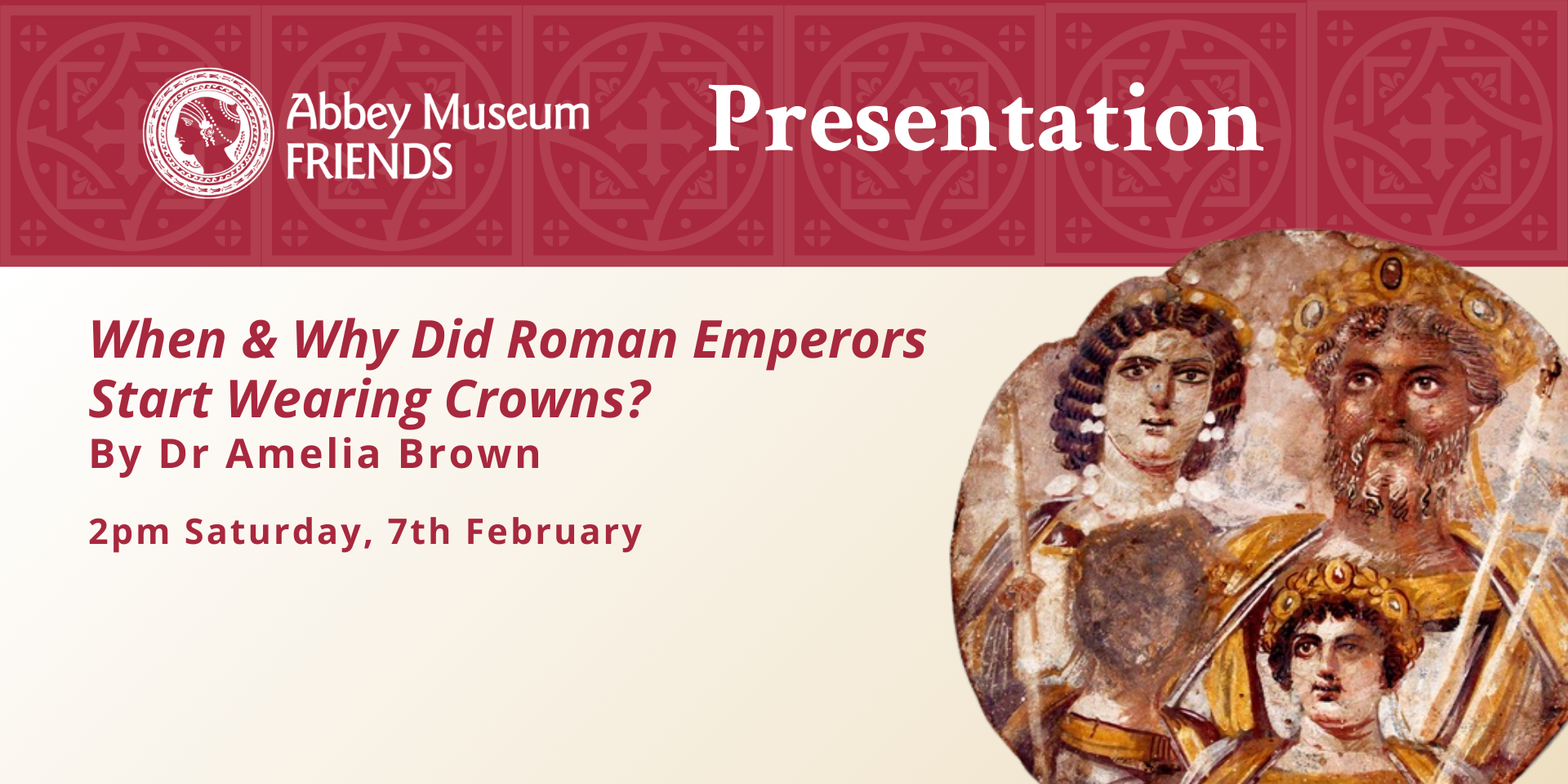
The Abbey Museum Friends invite you to their first Presentation of 2026 – When and Why Did Roman Emperors Start Wearing Crowns by Dr Amelia Brown on Saturday, 7th February at the Abbey Hall.
Crowns of gold, gems and pearls, along with regalia like sceptres, cross-bearing orbs and purple cloaks, are today some of the most recognisable symbols of royalty, or imperial power. Yet the first Roman emperors wore only oak or laurel wreath crowns, and a simple golden signet ring, as befitted their status as citizens, principes and triumphant generals. Even the first Christian emperor, Constantine, was shown on many of his coins wearing only a simple ribbon or diadem headband. As part of the Australian Research Council project ‘Images of Power: Roman Mass Media and Imperial Cult, circa 79 to 450 CE,’ Dr Amelia Brown explores when, how and why Roman emperors, and their high officials, elite subjects or court artists, created distinctive modes of dress, jewelery and even Christian attributes for the emperor’s closet, ceremonial use, and official imperial portraits.
Crowns of gold and gems first imitated vegetal victory wreaths, then gained quasi-divine solar rays, while purple passed from a symbol of Roman citizenship to an imperial prerogative. Armor, cloaks and even the toga were made with more expensive decoration, so the emperor might stand out from the army or the senate. Sceptres and orbs passed into imperial imagery from the attributes of the gods, but also via the powerful legacy of Alexander the Great and Hellenistic kings. Only a limited number of people actually saw the emperor himself, however, to appreciate and respect the status of almost unlimited power which these attributes signalled.
Images both large and small of emperors, empresses and their family circulated widely in the Roman Empire, though, from coins to glass phalerae medallions or military awards, frescoes to busts to life-size statuary standing in temples, basilicas, shops, banks or public offices. Yet how could their imperial subjects ‘see’ that this image was the emperor, and then recognise the new Christian dimension of emperor Constantine, or his dynasty? Portraits from Constantine to Theodosius and beyond show many pre-existing symbols of Roman imperial authority and dress unchanged from Diocletian’s tetrarchy, or even Hadrian, and gradually others newly-Christianised, such as the crown, orb, sceptre, spear or military armor. Crosses, chi-rho’s and other Early Christian symbols previously separated from the imperial office thus became part of the imperial imagery of power all across the Roman empire.
Join Dr Amelia Brown as she unpacks some of the underlying symbolism of the first regalia of the Roman emperors, its significance to a wide range of viewers, and its contexts of display on the emperor’s person and on his portraits. For assuredly these new Roman and Christian attributes of imperial power had enduring political, artistic, and especially religious impact on all later rulers, audiences and portrait makers.
Event Website URL: https://abbeymuseum.com.au/event/agm-and-presentation-by-dr-amelia-brown/